Tuesday, May 15, 2012

Fishing Etiquette for the Non-Boater

As long as I can remember, fishing trips with my Dad have always instilled in me a set of unsung rules that every fisherman should abide by.  The setting and type of fishing may change slightly from day to day, but the basics should always be followed to create mutual respect between yourself and others you may come in contact with.  This doesn't just include a friendly wave as you pass by another fisherman...or moving to a different spot if your favorite spot is already taken...there is a lot more to it when fishing competitively.

Competitive fishing from the back of the boat is not something to take lightly.  In most instances, like in my case, you will get paired randomly with a new boater each tournament.  Other competitions are team based tournaments where you fish with the same guy every time, but again etiquette is not exactly treated the same in both instances.  

First and foremost, when you get paired up with a boater at the beginning of the tournament ALWAYS get ground rules squared away before you even hit the water.  Let him know how much equipment you are bringing and never put anything into their boat until they tell you where you can put it.  Treat their things as your own! Find out what their fishing game plan is beforehand so you can leave any gear at the dock that you won't be needing.  It is not the non-boaters privilege to dictate where and how you will be fishing for the day in most instances, so just be cautious of this before you take off.  But in the same respect, let him know what you found during practice because it will help both of you solidify a game plan before you even leave the launch. After you get all of your equipment and a game plan set then it is time to get the boat in the water ready for launch!

If you have never backed up a boat before...you need to learn!  Learning to back up a boat and park a boat and trailer is one of the biggest things that you can do to help out your boater.  I had no idea how to back up a boat the correct way the first tournament I was in, so find a buddy that you know that can back up a boat or kindly ask the boater to get you close to the water so you can back in the rest of the way.  Don't be shy to tell your boater if you don't know how to do it...and if they know you have a hard time with it...some will actually allow you to take the driver's seat and guide you so you do learn.  Trial by fire is sometimes the best way to learn in a pinch.  When pulling the trailer away from the boat always wait until your boater gives you a go ahead signal...the last thing you would ever want to do is take off too soon and damage their boat.  If you aren't comfortable parking a boat and trailer always park in a farther spot away from others...and always take wide turns when swinging in a trailer!  A lot of this is probably not new to most of you...but you would be surprised how many people just can't figure it out.

^^^ Great how-to video to get you started ^^^

When you finally park the trailer and truck, always follow the boater's request as to where to put the keys.  Some leave it behind the flap of the gas tank, and some might want to have them back on the boat....irregardless DO NOT lose them!  You wouldn't believe the stories I have heard of non-boaters forgetting they had the keys...went down to mess with their tackle box and had the keys fall out of their pocket and into the water...DOH!  So always give them back to the boater or put them in a safe compartment...so at least if the boater drops them in the water it doesn't come back on you.  

After getting in the boat take some time before the launch to spark up some conversation.  It will make the day a lot more enjoyable if you can establish some common ground with your boater, and it might even allow you the opportunity to eventually have more free reign of their boat.  Once you come up to your first fishing spot there are some things that you need to abide by and be aware of to keep the peace at first between you and your boater.

1) Never put a line in the water until your boater puts his line in the water.
2) If you are flipping or fishing perpendicular to the shore you should not cast any further then the center of the boat.  If you are paralleling the shore with a crankbait or spinnerbait you should never cast in front of the boaters last cast.
3) Never fish off the front of the boat unless the boater invites you to the front of the boat...same goes for working the trolling motor.
4) If a boater misses a hook set on a fish abide by rule 2...
5) If you get hung up or snagged it isn't the responsibility of the boater to get you unstuck, but 9 times out of 10 they will give you a chance to get your bait back...but don't expect them to drop everything that they are doing and do it right away.
6) If a fish is hooked and a net is on the boat, always be prepared to net the fish for your boater...the courtesy should be reciprocated then back to you if you catch a fish.
7) Make sure all of your gear and tackle remains out of the aisle and is put away before the boater even sits down at the steering wheel so you can leave quickly from a spot to go elsewhere
8) Realize the fact that the boater is not your fishing guide, they are not required to put you on fish...you need to learn to adapt and fish the most effective way according to how they position their boat.

Some boaters are different then others so you just have to feel them out, but the rules above are always a necessary starting point.  Don't be shy to ask questions on what he is using or how to do what he is doing if he is catching fish...most guys are more than happy to teach you a thing or two.  If your boater though constantly positions you poorly let him know about it, you have just as much right to get a clear shot of water as they do even though they are running the show.  The main thing though as a non-boater is to learn, once you get a few tournaments under your belt these types of things will become routine...so soak in as much as you can!

At the end of the day it is always good practice to have the the non-boater go and get the boat and trailer.  After you get everything settled in the parking lot always offer to help clean up the boat and wipe it down...especially cleaning up your own mess.  You really don't realize how much extra time it takes to take care of a boat, so a little help on your part can go a long way.  Always talk about your day afterwards and re-cap what you did right or wrong...it always helps to keep yourself informed for next time.

The last thing you always want to do is give your boater some money.  The minimum amount of money should always be half of the gas used up during the tournament...but I usually give them a couple extra bucks in case we burned up oil or used any of his lures or ate any of his food.  Always make the effort to give them at least that...some guys won't take your money but it is better to offer it instead of not at all.

Being respectful of your boater will only do good things for you. Word travels fast in those small groups of fishermen so the last thing you need is to be pegged as an a**hole...it will save you a lot of grief in the long run.

That's all I got so if you want to read more on the topic and some other pointers to keep in mind here is where I found most of my information beforehand...

Thanks for reading, and tight lines!

Fluke

Monday, May 7, 2012

Clinton Lake: ABA Tournament #2

Last week I got a call from one of the club members of my bass club that wanted to head down to the Clinton Lake ABA tournament on Sunday.  Couldn't pass up an opportunity to get my feet wet on another new lake so we planned on leaving early Sunday morning to head down Clinton, IL.  What is nice about Clinton Lake is that it is very similar to Lake Shelbyville as far as cover, water depth, and lake contours go.  The only added twist to this was that Clinton Lake is a cooling lake.  So water temperatures are always higher than other local lakes and ponds especially during the cooler months of the year.  I had no idea about water clarity and water temperature so it was kind of crap shoot what to expect.  Knowing that this body of water was similar to Shelbyville I went to Bass Pro the night before to stock up on a few things.  The first being some deeper running crankbaits.  I wanted these to be on hand because I had a suspicion that the bass were already moving into a post spawn pattern.  I knew the week prior from other sources that fish were on beds already...and considering it was a cooling lake the water temperature would probably accelerate this process and push them into post spawn relatively quickly.  From what I understand in most cases after the spawn bass retreat to deeper water off of the shallow bedding areas to recuperate.  So deep diving crankbaits as well as weighted texas rigged plastics and big spinnerbaits would probably produce the most.

I have a couple 7' crankbait rods that are great for shallow-medium divers but in order to get the full effect of a deeper diving crankbait I decided to pick up a longer crankbait rod in order to get more casting distance.  I had a Shimano Compre deep diving crankbait rod previously, but it was way too tip heavy and awkward for what I needed...so I sold it and now needed to find a new one.  I decided to pick up a 7' 6" MH Boyd Duckett Crankbait rod.  I took a chance on some of the Ducketts last year and really liked how light and durable they were...but I really couldn't find any application that they really shined on.  This ended up not being the case with the crankbait rod.  I ended up throwing that  setup 70% of the day and it worked out perfect!

Immediately in the morning my boater, Matt Bennett, and I started shaking down some rip rap (shore with multiple types of cover) near one of the main brides.  I tried plastics...didn't work, I tried a spinnerbait...nada, and I tried a crankbait...ended up losing it.  What to do now???  The water temperature was around the 72 degree mark and the water clarity was about 1.5-2 feet (similar to Shelbyville) and had a green tinge to it.  My boater didn't get a bite at our first spot either so we moved.  It took a few spots until we finally started getting into them by one of the other boat launches.  There was a rocky ledge next to the launch so we started working that first.  Most ledges on Clinton and Shelbyville have really steep drop offs...transitioning from 5 to 15-20 feet relatively quickly.   I picked out one of my Strike King 5XD crankbaits (diving depth of 15') and threw it close to shore.  A couple turns of the handle and I could already feel my bait come in contact with the rock on the bottom...exactly what I wanted!  I had to be careful not to continue cranking after the crankbait dug into the bottom because I could easily get snagged on rocks and other debris.  I would pause as soon as I hit bottom, raised the rod tip up to get it out of the rocks and put my rod tip back down and use the rod tip to pull the crankbait along.  As soon as I would hit rock, I would pause every time...then reel in the slack and use my rod tip to pull the crankbait forward again.  It took about three casts and BAM first fish nailed it on the pause!  It was a nice fat largemouth...but after throwing him on to the bump board he was just a hair under 16".  For this Lake, like many others, there are different slot limits.  Clinton lake allowed you to keep 3 fish at a minimum of 16"...so anything smaller had to be thrown back.  

It was a good sign to finally land a fish so I primarily fished the crankbait the rest of the day.  I tried throwing plastics and spinnerbaits for awhile but it was pointless considering that the bass were no longer on beds and the carp in the lake were spawning on the shore and muddying up most of the water.  A few spots later around 10:30 we got onto a small point.  I threw the 5XD crankbait a couple times and finally got bit again after banging against the rocky bottom.  I felt the "bump, bump" of a fish...I paused a short 1 count to allow the fish to inhale the crankbait and I set the hook on him pretty hard.  Next thing I know my first 3+ pound keeper comes sky rocketing out of the water! Luckily that Duckett rod had a lot of play to it and it kept those trebles pinned well inside it's mouth.  First keeper was in the boat!

We continued to build upon this pattern and my boater eventually switched to a deep diving crankbait like I was doing.   We caught a decent amount of short fish but it seemed like every area we would pull up to we would only catch 2-3 fish and then the action would go dead.  We pulled into a cove around 12 and my boater got his first 16" keeper of the day in a little pocket with a green pumpkin creature bait.

It was about 1:30 and we only had an hour and a half to come up with some more fish.  After asking around it seemed like most of the people in our tournament only had 1 keeper in the boat.  We still had a chance but we needed to find at least one more keeper a piece to still be in the game.  We pulled up to a steep shoreline that had a bunch of lay downs in the water.  We worked the area over well and we only had another 20-30 feet of shoreline before we were going to move again.  I threw my crankbait right up along side of one of the lay downs next to the shore...a few turns of the handle and I paused the bait.  I went to go turn the handle again and I just felt a weight on the end of the line.  I thought I got snagged again because I had lost several crankbaits to rock and wood during the day.  Then I saw the tip of my rod bend...I had a fish!  I set it hard and she took off straight towards the boat.  I reeled in fast as she darted towards me and then she dove down quickly as my pole doubled over.  I got her to finally swing up towards the surface...she was a TOAD!  Then I saw how she was hooked and she barely had two of the back treble hooks in her mouth...CRAP!  My boater dropped everything and got the net.  A couple more good runs and we finally got her in the net.  I just stood there in disbelief after seeing how big the fish was...legs were shaking, hands were shaking...holy cow!  I thought my first fish was decent but after putting this pig in the livewell I was afraid she was going to eat my other one.

Unfortunately right after I caught my last fish we had a dead battery on the boat and had to improvise to get the motor cranked over.  We counted our blessings after finally getting the motor started and decided just to head in early to the weigh in since it was getting close to 3 o'clock.

I weighed my big bass...she tipped the scales at 5.32 lbs and with my other fish I had a total of 8.74 lbs...just could not believe it!  My boater weighed his one fish for a total of 2.52 lbs.  Most of the field weighed in 0 or 1 fish for an average of 2-3 lbs...even had an 18" smallmouth weighed in that was 2.56 lbs.  A few people besides myself had 2 fish and averaged 5-5.5 lbs.  I thought I had big bass until my boater's friend came in with a huge female...5.75 lbs which was enough to get him big bass of the day and 3rd place!  Mike Pappas, another ABA regular, came in with the only limit...we knew he had a good sack of fish when he showed up. He weighed in a little more than 13 lbs...caught all of them on a Zara Spook early in the morning.  My weight was good enough to put me right behind him in second place.  If that other short fish I caught would have went I probably would have had around 11.2 lbs...still not enough though to get first.

Just could not get it to sink in....a fourth place finish last week and a second place finish this week...just unbelievable.  Lucky streaks like this are rare, but I am going to work hard to try and keep the momentum going if I can.  My boaters played a huge role in my success the last couple weeks and I am really thankful for all of their help!!!

Here is a picture of the two fish that I weighed in...just amazing the size difference between the 3 and 5 pounder!


I had my 7' 6" Duckett cranking rod paired up with one of my new Daiwa Zillions (6.3 gear ratio)...the setup  worked out just how I wanted it to!  The three colors that produced for me were all of the gizzard shad colors that Strike King makes.  The blue gizzard shad produced the most for me and mimicked the bait fish in the lake the best.  Another lure that caught a couple fish also were the Rapala DT10's in Disco Shad.  The Strike King colors can be seen below.  Just as a side note...I lost 6 crankbaits during the day.  I know most people get leery after losing one lure but you have to remember that running crankbaits into different types of cover is what will get you bit more often than not.


Just another awesome day out on the water.  It was rough waking up at 1:10 in the morning to get down to the lake by 5:30...but it was well worth it!  If any of you have the opportunity to fish an ABA tournament, do it!  A ton of great guys in that bunch and you will get to learn a lot from other people.

Thanks for reading and tight lines!

Fluke

Thursday, May 3, 2012

Need Some Prayers...

In the last few months my cousin, Matthew Mammosser, has had to face one of the most difficult things any human being has had to endure...cancer.  Back in January of this year he was rushed to the hospital due to flu like symptoms only to find out that he had a mass between the two hemispheres of his brain.  Since then he has had several surgeries to remove the tumor as well as complications with blood clots and infections thereafter.  He has gone through several chemo treatments already so he is heading in the right path to fight this disease head on.  It wasn't until today that I found out that his doctors found more tumors.  I am still in the dark as to the severity of them...but I am hopeful that he still has a long road ahead of him to recovery.

Matt is only 18 years old, but he has made his mark in our community and has made a ton of friends along the way.  He was born deaf but has had a hearing implant for most of his life so he is as normal as any 18 year old can be.  He is currently going to Joliet Catholic Academy highschool and is one of the best defensive players on their football team.  He was able to help them get all the way to the State finals last year but unfortunately came up short.  Next year will be his senior year and the coach of the team already has placed him as the Captain of the Defensive Line.  On top of this he has been competing in weight lifting meets and hopes to one day hold the squatting and benching record for JCA.

It is amazing to me how far this kid has gone from a scrawny freshmen to a 6'2" 245 lb junior.  He has worked his butt off to get where he is at now to only be fighting for his life.  All he wants to do is be on the field next year but unfortunately he has a long road ahead of him to fight this.

I am asking all of my readers and followers to pray for my cousin and our family as he goes through this rough time.  You really don't realize how difficult a situation like this can be until it hits this close to home.  He is too young to have this happen to him and I hope that God is definitely looking out for us as we speak.

I am really lucky that I have the opportunity to live my life in the path that I chose for myself, I just hope and pray that he is given that same opportunity too.  Life has a funny way of smacking you back into reality...but I have faith that things will work the way they are supposed to.

If any of you would like to help my cousin's family there is a link on top of my blog that says "Please Support my Cousin Matthew!"...this will take you to a website that his friends and parents of JCA have put together to raise money for Matthew's surgeries and care.  You can also purchase a T-shirt that has the JCA logo on it and my cousin's football jersey number on the back.  It also will give you updates as to how he is progressing.

Thank you in advance to anyone that sends prayers our way...it is what keeps us glued together and hopeful in this time of need for him...

Fluke

Monday, April 30, 2012

Lake Shelbyville Aftermath

Finally back from my fun filled weekend, and all I can say is I am beat!  Both days were filled with rain, wind, and cold temperatures...the cold front was in full swing.  Saturday we hit the lake around 7:30 AM, and started a mile or two South of our launch area and worked our way North up to the two rivers that feed into Lake Shelbyville.  Lake Shelbyville in general is a beautiful lake with a lot of sparse stump fields, brush piles, rock piles, drop offs, and flats.  Having intimate knowledge of this lake is crucial because the water level varies dramatically from spring to summer.   At "winter pool" which is what the lake is at now is about 9-10 feet down from what the lake is during the "summer pool".  You could tell just by the erosion of main lake points how far down the water was from normal summer pool levels.  

A good starting tip that I learned from my club boater, Mike, on Saturday was that the spawning period for the lake was usually in mid May.  This was one of the key points that I had to soak in because it told me several things...that the males are starting to move up to spawning areas, and the females will probably be lurking in some deeper water or might have started moving up depending on the portion of the lake they are in and the water temperature.  Water temperature on Saturday was about 56 to 59 degrees depending on the time of the day which was perfect for most lures that I wanted to use.  Water clarity was varied again depending on where you were at, but you could see about 1.5 - 2 feet down.  This wasn't great so I knew that brighter colors or really dark colors would have to be key.

We hit several areas throughout the day, picking up a few keepers here and there with a mix of some hybrid white bass.  Crappie fishing was in full swing there also so we worked our way around the chunks of boaters working brush piles for their dinner.  While we were doing this I was making note of the areas we were fishing by marking way points (exact fishing spots) on my Navionics app on my phone.  This app is 10 bucks, but allows you to drop pins on a lake map using your GPS location from your phone making it easier to hit your spots the following day.  Water temperature, type of cover, water depth, and water clarity were all necessary pieces to the puzzle that needed to be figured out.  The main thing though was to cover A LOT of different water quickly...and once you get that first bite you will be on your way to developing a pattern.  

My boater, Mike, kept on getting hits next to stumps in our second area (the first area was a bust).  The stumps were in 5 feet of water but had steep drop offs near by (secondary points).  The stumps that were consistently holding fish were primarily next to main lake points.  Now, I am a novice when it comes to lake contour lingo...but a main lake point is a land structure (usually a peninsula) that works its way down into the water...something that you can visibly see from shore.  As you can see in the picture below, a cliff on the left side runs into the lake down to five feet of water where it flattens out.  That is what would be called a main point.  A secondary point though is when that depth transitions then to a deeper physical contour of the lake bottom...in this case the contour drops down to 12 feet of water and then flattens out again.  So whenever you hear someone saying main point or secondary point, this is what they mean.


Not only were we catching fish on stumps next to main lake points, but also at gravel walls next to marinas and bridges.  Mike caught a nice female next to one of the mouths of the bridge on a crankbait.  The female was full of eggs and still feeding on shad.  What is important to note was the condition of the female's tail. The tail isn't fully stretched out flat in the picture...but a good indicator whether a female is actively moving for the spawn is a bloody or red hued tail.  When the females start filling with eggs they sit lower in the water column and hug the bottom because they are heavier and don't expel much energy.  When they swim around then, they end up rubbing their tail on the bottom causing a non-permanent wound on their tail. The fish below did not show signs of this so she was still active and will probably be moving up soon for the spawn.  Up to that point, all males had been caught...so an active female was a good sign that we might have some bigger fish in the bag come tournament day.


Stumps and rock points...we had our game plan.  Most fish were caught between 5-10 feet of water and the water clarity was murky.  The shad were in full swing and a lot of the bass were keying in on that so crankbaits were picked meticulously to match the hatch of the shad that we saw jumping out of the water.  Light whitish grey sides with a light silver/pale black back was the key.  KVD 2.5, Strike King 5 and 4 series crankbaits in Green Gizzard Shad and Blue Gizzard Shad worked the best.  Spinnerbaits were also used, but the right color combo/blade configuration wasn't figured out until tournament day...but we will get to that juicy detail later.  Black/blue jigs, black and blue creature baits, and green pumpkin senkos around stumps and brush worked well also.

The main thing we focused on though during practice on Saturday was to only set the hook on one or two keepers in an area once we found them, because if you catch a bunch of fish in the area...it will more than likely not produce on tournament day.  A lot of the fish hit our bait and we let them shake free without setting the hook so they would bite tomorrow.  Once we located fish in an area, we marked that point and made note of the characteristics of that area, and then made our way to a new area with similar characteristics.  By the time we were finished we had 6-7 areas that we knew held fish that were willing to bite.  I made note of all of this information, but come tournament day I might be fishing some totally different areas and lures depending on who I drew as my boater.  That is the dilemma of the non-boater and practice...you are at the mercy of your boater on tournament day no matter how well you did in practice in other areas. Practice should still be utilized as a tool familiarize yourself with the water and the fish patterns to prevent you from getting overwhelmed and over thinking things.  I have to say it helped me out getting my head in the game and having ideas in my back pocket that my boater might overlook.

Tournament Day

Tournament morning started at 5:45 AM with check in...followed by drawing for boat order number and non-boater draw.  My name was called out and I ended up picking boat number 5.  Boat number 5 belonged to a local guy named James Williams.  Really great guy, and ended up learning a ton from him throughout the day.  He had been pre-fishing for the last 3 weeks patterning the fish, so I knew we were going to get into them.  The day called for severe weather and a little colder temperatures...but James and I were in for a little bit tougher day than expected...and not just from the weather conditions.  From the get go he was having issues starting the motor.  Everyone took off and we were left stranded on the trolling motor until one of his buddies came to give us some starter fluid.  The motor luckily started up and we ran to our first area.

The starting spot was in one of the fingers of the lake...stumps and trees galore!  I tried a black/blue jig for a while with no luck.  James threw Texas rigged plastics but had no luck either.  About an hour into picking the area apart...the rain came.  Thunder and lightning started to come in but we stuck it out for a bit as the rain was pouring.  I decided to switch up tactics and put on a white/chartreuse spinnerbait with gold and silver colorado blades.  I threw that for awhile until I finally got my first bite of the day.  We were way back in one of the fingers of the lake and I saw a lay down tree under the water parallel to the shore maybe about 2 feet down.  I threw the spinnerbait right up next to it and slow rolled it after it sank down a bit.  I wasn't fully paying attention until I felt a heaviness on my line.  I had gotten hung up a few times that day so I figured that was the case...until my line started moving.  I realized that it was a fish and I laid into her!  Next thing I know she was off to the races!  My boater dropped everything and scrambled to the side of the boat to help me.  As soon as I saw the side of the fish I knew she was a big one and my heart started racing as she splashed around in the water.  My boater finally lipped her and she was on the board, what an amazing feeling!  I guesstimated her at 4.5 lbs but my boater knew she was heavier then that...we had to wait and see once we got to the scales.  

The storm started getting worse with the lightning and thunder being right over the top of us so we went into a cover for a bit and waited for everything to roll through.  Once it started letting up we went to go turn over the motor...didn't fire.  We tried and tried to get it to run...no luck.  It took us awhile to figure out what went wrong...and with a little help from another couple guys on a different boat we finally got it to run.  Unfortunately we lost a good hour in the tournament, but we tried hard to recover quickly.

We fished a few more spots with no luck and finally headed over to a rock break wall that was next to a marina.  James told me that this marina was where most of the tournament fish are released so we were sure to fill the rest of our limit fast if they were biting.  James picked up two keepers quickly on a jig and creature bait and I picked up my second one on a KVD 2.5.  Mind you, all of the keepers had to be over 14" so some short fish that we caught had to be tossed back.

We hit a few more areas with no luck, it wasn't until 10 minutes before weigh in that we found one more fish.  James tossed a spinnerbait (same chartreuse/white one I had) at another lay down tree and saw a fish roll on it.  The fish missed it and he immediately threw his creature bait in there.  He hooked into his third keeper which was a fat 14" bass.  I was too slow on the draw and I ended up missing that chance to capitalize on his miss...oh well, you live and learn.

We finally got into the weigh in...I was really excited to weigh in my fish because it could have very well been the biggest bass of the tournament.  A lot of the boats surprisingly were missing from the parking lot...some left because of the rain and others had no fish so they took off early.  I had a good chance!  When it was my time to weigh in I pulled out my big bass and the feeling was just indescribable.  She weighed 5.17 lbs!


The other fish of mine weighed 1.6 lbs so I had a total weight of 6.77 lbs.  I didn't think that was enough to place because I found out Bob Pointer, another member of our club, weighed in 5 fish for 15.57 lbs.  His big bass weighed 5.46 lbs.  I didn't know how the rest of the field fared so I went and released my fish and headed back to the weigh in for the announcement of the winners.  They paid out up to 6th place.  It didn't dawn on me until they called out 6th place that I actually had a winning weight!!! My two fish were good enough to put me in 4th place...out of a field of 37 anglers!  I was just shy of big bass too by .29 lbs!  I walked away with $150 bucks for 4th, and Big Bass would have been an extra $190...I was on cloud nine either way.  I beat 10 out of 13 of our club members, and I caught my biggest bass of the year...I just couldn't believe it!

I ended the day talking to my boater James and thanking him for all of the help.  It was awesome to place in the tournament, but learning from someone who is a veteran tournament fisherman was priceless.  I owe him a lot of the thanks, and all of my club members the same as well for making this tournament a memorable one. It was a great time, and the fishing gods were looking out for me.

Mike and I left the lake Sunday afternoon...and another fishing memory was in the books...


Thanks for reading, and tight lines!

Fluke

Thursday, April 26, 2012

Prep for Lake Shelbyville Tournament (4/29)

Tournament number 2 is finally on the horizon, got my gear all packed up and ready to go to hit the road tomorrow afternoon.  This tournament will be a little different this time around because I have never fished this lake, and I will actually have a full practice day to see if I can develop some sort of pattern before Sunday.

The inner workings of tournament fishing is still really new to me so I have been taking it in stride learning the ins and outs of what I really need to focus on.  The Shelbyville tournament is actually an ABA (American Bass Anglers) tournament, which is a separate tournament trail from our regular club tournaments.  Even though this is the case, we are using a couple of the ABA tournaments as our regular season club point tournaments since the trail is technically still under the FLW division.  One thing I recommend to all new tournament anglers...if you are fishing in more than one tournament trail you have to be a member of that tournament trail in order to participate.  Good thing I was reminded of this because I just bought my membership a couple days ago and registered online for this tournament.  Without the membership, I would not be eligible to compete. What will be nice though is that I can compete in any ABA tournament outside of my club if I decide to do so in the future.

Pre-fishing is a relatively new thing to me also so here are a few things that have helped to speed me up over the last few weeks...
  • Topographic Maps of Lake Shelbyville
  • Weather patterns
  • Recent tournament weigh ins and weigh ins from last year
  • Average fish size and bigger fish for the lake
  • Current water clarity and water temperature
  • Prominent food sources
  • Prominent type of cover
  • Talking to other people who have pre-fished the lake
  • Average water depths
Having an idea of all of these things before you even see the lake can be very useful in helping you break your game plan down into smaller chunks.  The topographic maps can usually be found online.  Some of the better ones take some digging but I managed to scrounge up a few decent ones.  Since this is an Army Corps of Engineers lake, some really detailed topographic maps can be had relatively easily.


The weather has been nice, mostly in the 70's all week but starting today the temperatures have dropped down into the 50's.  This means a big cold front has just moved into the area and the fish might be harder to catch.  Finesse tactics as well as slower reaction strike presentations might work better than anything else come Sunday.

After reviewing recent tournament weigh ins it was evident that there is some size to most of the fish in the lake. 1.5 to 2.7 lbs seem to be the average size with a few fish reported in the 5 to 6 pound range from previous years.  A tournament that took place a couple weeks later this time last year had a winning weight of 17.75 lbs.  The weather conditions probably weren't the same, but I know now that it will probably take around 3 lbs a fish to come close to first depending on how the rest of the field fares.

http://www.lakeshelbyville.com/images/Event%20Images/Fishing/2012%20Fishing%20Report.pdf

After speaking with one of the other guys from our club who pre-fished the lake, the water clarity has been stained the last couple weeks. Now with the cold front and the rain coming on Saturday it will be a guarantee that the water temperature will be slightly colder and stained for Sunday.  He also let me know that a lot of the fish have been feeding on shad, so with the weather patterns and the time of year...the fish are probably likely to be in their pre-spawn staging areas or possibly backing off more now to deeper water with the cold front.

Another member in our club who fishes Shelbyville quite a bit has helped key me into the type of cover that I can expect this time of year....rock and wood.  There are a few old road beds that could potentially hold fish as well as numerous stumps and lay downs in the channels and fingers of the lake.  So both will be worked over pretty well to see what form of structure the bass are keying in on.  Water depth of the lake varies depending on where you are at from 5 to 40 ft, but once the structure is patterned...the water depth that they are holding at will be the next key to the puzzle.

So what do I get from all of that?

This is the dilemma now of the non-boater.  Even if I developed a pattern on Saturday I am at the mercy of my boater that is chosen for me come tournament day.  Even though this is the case, I should still have anything I learned in practice in my back pocket just in case.  Finesse techniques will probably be more effective with the cold water, such as dropshotting and shakeyheads.  Dark colors as well as really bright colors will have to be used since the water is stained.  Reaction baits with a lot of rattle and water displacement such as Colorado blade Spinnerbaits, rattling jigs, rat-l-traps, crankbaits, and chatterbaits will probably be used.  Also shad style lures will probably be productive since most of the fish have been keying on shad this past week.  So jerkbaits and soft plastic jerkbaits can be added to the list as well.

I plan on bringing only 5 rods and reels with me to the tournament so this is what I limited myself to...

(2) Crankbait setups for rat-l-traps, jerkbaits, squarebills, and deeper divers.
(1) Finesse spinning setup for dropshot, shakeyheads, and flickshake
(1) Heavier jig setup for swimjigs, rattling jigs, and swimbaits.
(1) Spinnerbait setup for chatterbaits and spinnerbaits.

Some of my starting lures will include...

  • Shad pattern or all White spinnerbait and chatterbait
  • 3/8 oz black/blue rattling jig
  • Dark Texas rigged craw/creature bait
  • Black/Silver Lucky Craft Pointer and Rapala Shallow shad Rap
  • Black/chartreuse and Black Silver 1.5 and 2.5
  • Zoom Finesse worm and Roboworm for finesse techniques
  • Silver/Black Back Red Eye shad
I am sure other techniques will work there way in, but it is always good to start out with your confidence baits.  After taking the time to go through my game plan I feel more mentally prepared even though I haven't set eyes on the lake yet.  I will shoot out a short update Saturday night with my progress and let you guys know how I am doing so far.  20 boats will be at the tournament come Sunday so this will be double the size of our last tournament.

Wish me luck, and tight lines!

Fluke

Monday, April 23, 2012

So they call you Fluke?

It still shocks me and people around me when I get someone shouting "Fluke" across Bass Pro followed by me turning around with a confused look and realizing another DupageAngler.com member has spotted me.  Fluke is a relatively new nickname, but the meaning behind it has stuck with me for easily 10 years of my fishing career.  Of course I get the comedians that like to say, "is it because it's a Fluke when you catch a fish" which is immediately followed up by a chuckle if you know me, or a good shove into the nearest body of water if you don't know me. Haha.  But in actuality I call myself Fluke because of the Zoom Super Fluke.

The Zoom Super Fluke has been a staple in my line up every year for the past 10+ years of my fishing career, and I have cut my teeth learning and understanding weightless plastics because of it.  The Fluke is one of the most versatile and productive baits that I have ever come across and I continue to use them year after year because the flat out produce results!  I feel like Bubba from Forrest Gump talking about shrimp sometimes...but there are so many ways to change up the Super Fluke that it is almost impossible to fish this lure incorrectly.  So sit back and relax as I go over 5 of my most productive ways of rigging and fishing the Zoom Super Fluke!

1) Carolina-Rigged Zoom Fluke

Ideal Setup:
Rod: 7' 3" MH or H power with a Fast action
Reel: 6.4 Gear Ratio
Line: 17-20 lb Fluoro leader with 50 lb Braid main line
Hook: 3/0 EWG hook
Weight: 3/8 - 1/2 oz Bullet Weight

If any of you have used a Carolina Rig you will understand why this lure is so effective.  I had a chance to do this type of fishing down at Lake Fork last year near Alba, Texas and it was surprising how many people used the Fluke as the bait of choice for this rig.  With any C-Rig you have a bullet weight, plastic bead, barrel swivel, leader, and a hook.  The leader can vary slightly in length depending on where you are fishing, but the guys down in Texas usually use an average of  3'.  They put the bullet weight on the line first, followed by the bead, then by the barrel swivel, leader, and finally the hook.  The Fluke is then Texas rigged on the hook and you are ready to go!  This rig is made for dredging the bottom and what some fisherman find important about using the Fluke is that it creates a "competitive" urge in the fish.  What I mean by this is that when you drag along the weight at the bottom it kicks up dirt and debris.  A bass keys in on that action and noise, but then they see a fish type looking lure following it.  Well the bass has to be the head honcho in the area and sees the smaller lure as prey and they attack it!  C-rigs are way easier to fish then they are to cast so here a few simple guidelines I learned when fishing this rig...

- When you cast a C-Rig your goal is to cast the weight...not the lure.  If you focus on the lure then you will cause more issues than not when you wind up to chuck that entire rig out to the water.
- When retrieving this lure you want to use your rod to pull along the weight at the bottom.  Once you have pulled it as far as you can go...reel in towards the rig to pull in the slack.  If you feel the weight hit cover...continue to drag the rig and SLOW it down!  You don't want to hop the weight or reel it in...you want to drag it along keeping that weight in contact with the bottom the entire time!


2) Dropshotting a Zoom Fluke

Ideal Setup:
Rod: 6' 10" Medium Power Xtra Fast Action
Reel: 6.2 gear ratio
Line: 8-10 lb Fluoro
Hook: 1/0 EWG
Weight: 1/4-3/8 oz Cannonball weight

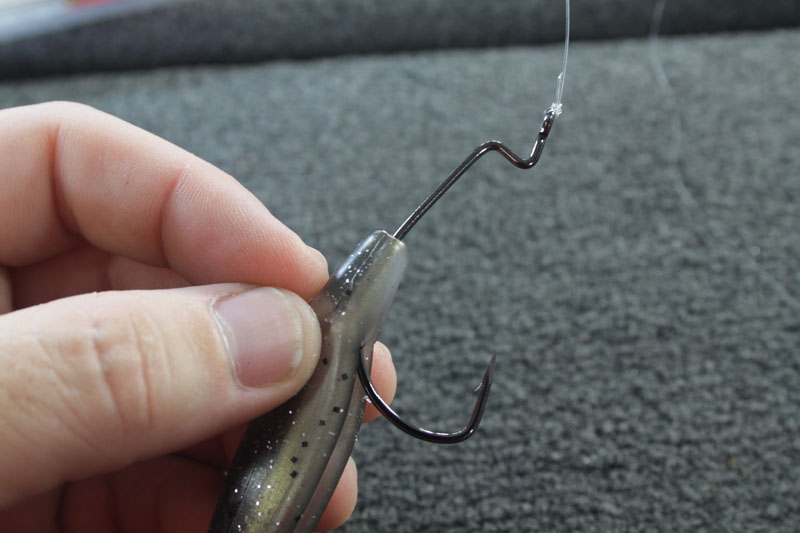
Drop shotting is a new technique that I covered in a previous post so look for more information there on how to rig this technique.  The main point I want to bring up is how to rig the fluke on the hook.  Ideally a smaller hook should be used so a 1/0 EWG would work perfect.  In this case you won't be Texas rigging this lure, instead you will be nose hooking the bait instead.  At the nose of each Super Fluke is a section of plastic that is at least 1/2" in length.  You want to bring the hook tip up between the bottom flaps of the bait and push the hook tip through the nose until it comes straight out the top of the bait (kind of like the picture below)  Toss the rig out...bounce it around off the bottom and wait for your line to start moving or the rod tip to bow over!


3) Donkey Rig

Ideal Setup:
Rod: 7' Medium Power Fast action
Reel: 6.2 gear ratio
Line: 10-12 lb Fluoro
Hook: (2) 3/0 EWG
Weight: No Weight
Swivels: (2) Barrel Swivels

The donkey rig is a new rig that I just recently started using, but it is probably one of the most fun rigs for the fluke that I have ever used.  In order to tie this rig you need 2 barrel swivels, 2 Zoom flukes, 2 3/0 EWG hooks and one 8 inch and one 10-12 inch fluoro leader.  First tie each leader to one barrel swivel at one end and then one 3/0 EWG hook at the other end.  Next take the "shorter" leader and run the main line from your reel through the other end of the barrel swivel. Next take your "longer leader and tie your main line to the other end of that barrel swivel.  If you did this correctly your rig should look like the picture below.


This rig is effective for a few reasons.  It creates a "schooling" effect between the two lures and  when you twitch the rod tip it forces the two lures to come together making it look like a feeding frenzy.  The bass react to the two lures competing against each other and attack it.  This rig would also be really great when bass are swarming on shad during the spring and fall!  Subtle rod twitches will be enough to cause the flukes to flutter and dart erratically.

4) Wacky Rigging

Ideal Setup:  Same rod and gear ratio as number 3
Line: 10 lb mono or copolymer
Hook: Circle hook (Octopus Hook)
Weight: No Weight

The wacky rigged fluke has been around for awhile and it is one of the easiest to rig.  Take a Zoom Super Fluke, push the hook point of the circle hook through the center of the bait on the flat side of the bait (not top) and you are finished!  Subtle rod tip twitches will make the bait bounce around like a wounded bait fish.  Also a great rig to throw when fish are schooling up on shad or throwing into weed pockets and up against different types of cover.


5) Deadsticking

Ideal Setup: Same rod and gear ratio as 3 and 4
Line: 10 lb mono or copolymer
Hook: 3/0 EWG
Weight: No Weight

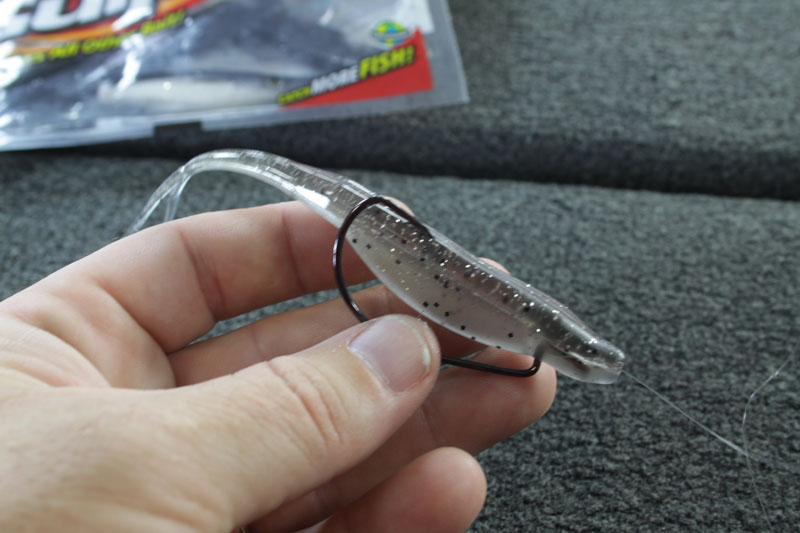
Now comes the moneymaker...the most sought after technique that I have been using for years!  Time and time again this rig produces during the spring, summer, and fall without fail.  A Zoom Fluke on a 3/0 EWG hook Texas rigged weedless and weightless is all you have to do.  The link below shows a good step by step process to how I EXACTLY rig my Zoom Fluke for this technique!


From this article there are three pictures that I really want to point out.  The first one is showing the hook point penetrating through the ENTIRE nose of the bait.  Bringing the hook point all the way through the nose helps to prevent the nose of the bait from tearing more easily and it conceals the knot in your line preventing it from getting damaged in high cover areas. (SEE BELOW)


The next important thing to do is make sure that the hook point then makes it up between the flaps of the bait and into the center of the back  Be careful not to stretch or scrunch the bait because it will cause the lure to "spiral" while you are twitching it along...that alone destroys the action of the bait. 


The last thing to consider is burying the hook point just barely under the skin of the back of the bait.  This subtle detail will make this plastic virtually weedless!


Now that you have the rig down, the next important factor is how you fish it.  Deadsticking is pretty self explanatory...throw it out, and DON'T MOVE IT AN INCH!  You want to make accurate casts on weed edges, pockets, brush piles, docks...pretty much any type of cover that could hold a fish.  Watch your line after the cast religiously because 70% of my strikes have been on the initial fall.  If you see your line sinking faster than usual...set the hook, if you see your line jump...set the hook, if you see your line go tight or move left or right of your initial target...set the hook!  If nothing happens on the first fall and your line stops sinking...give it a few twitches and let it sink again.  Let the lure sit for 8-10 seconds, twitch it a few times again...and let it sit. Repeat Repeat Repeat!

When you are "twitching" your bait your rod tip should be pointed down towards the water...not up in the air.  Your wrist is your main source of action for this bait and will allow you to control how quick or slow the side to side action of the bait will be.  Take some time to practice this retrieve and it will pay off dividends for other lures such as jerkbaits, topwater, and frogs!

Now that you know most of my secrets...here are some more regarding the colors I use...these colors are in order of favorite to "old stand by's"...

1) Watermelonseed
2) Green Pumpkin
3) Watermelon Magic
4) Watermelon Candy
5) Smokin' Shad
6) Albino Shad
7) Baby Bass
8) Smokin' Silver
9) Black

Take some time to learn these baits, water temperatures are getting to the point where these baits will be highly effective!  If you can learn to master this bait and be patient enough to understand when this bait will be used...a whole new door will be opened to you when using any type of plastic lure!

Like always, any questions you have feel free to ask!  Alan@DupageAngler.com

Tight Lines, 

Fluke

Monday, April 9, 2012

Expensive Backlashes, Snags...and Some 20's!

Easter weekend was right around the corner, so that meant nothing less than a 3 day weekend to get out on the water and do some relaxing!  The morning predicted temperatures for the weekend had dipped down into the frost zone so it was going to be a toss up whether this awesome spring fishing was finally dying down for now. 

Friday:

With no one home and Friday open to do some fishing I decided to brave the weather and head out to a local Naperville Forest Preserve Lake. Since the water temperature had dipped down I knew I was going to have to focus on a colder water bite...rat-l-traps, shakey heads, jerkbaits, and flat sided square bills were all ready to go on seperate poles.  Luckily I had my rain suit with me so the cold weather was a bit more bearable, but the winds were definitely unkind to my exposed face and hands.  I walked to my first spot and decided to use my shakey head for awhile that had a Yamamoto grub texas rigged on it.  I threw atleast a dozen casts hopping and dragging the shakey head along the rocks on the bottom trying to imitate a fleeing craw...but no takers.  I put the shakey head away and tried my luck with a suspending jerkbait...first cast...SNAG!  Tried popping it loose for a couple minutes but eventually conceded defeat...there went a 16 dollar Lucky Craft Pointer >: (  Lake 1...Fluke 0.  I switched back to the shakey head...threw about five more casts still ticked off about losing such an expensive lure...but then finally felt a hard thump from a hungry bass.  Took about a minute to get him in but fish number 1 was on the board for today.  38 degree air temperatures and 10-20 mph winds and I was able to land a fish.  I could have not cuaght anything the rest of the day...and I would have been perfectly happy with the fact that I got rid of the skunk on a day like today.


After I landed that one I decided to move over to a different spot on the lake where I had luck earlier in the week at.  What was unique about this area was the combination of sparse vegetation, big and small boulders, less exposure to the wind, and somewhat of a significant dropoff from the shore.  The main things that I thought were significant was the decrease in wind (for my sake mainly), and the fact that there were alot of rocks there. Rocky bottoms are one of the best forms of heat sources for bass when the water temperatures are colder.  I took out a flat sided Lucky Craft Squarebill and started performing the same retrieve I used last Wednesday.  I use the rod tip to pull the lure towards me and then reel in the slack towards the lure to give the lure time to float back up.  This caused two important things to happen...allowing the bait to be pulled deeper to the rocks allowing it to collide and deflect with the cover...and then upon retrieving the slack, you allow the bait some time to float up in the water column slightly to give on looking sluggish bass a chance to strike.  I threw the squarebill out...pulled the lure twice...hit some rocks...paused...and FISH ON!  Bass number 2 was landed and he was a fatty!  2 lbs 12 oz and probably 16" in length.  A nice fish to bring to the scales any day of the week.


The pattern worked perfectly on the first cast...but bad luck set in catching a fish on the first cast with the new lure and there were no more takers to be had in the area.  I decided after a few dozen casts of the squarebill that the water temps might still be too cold for the erratic action of the squarebill.  I then switched it up to a Rapala Clackin' Rap.  Knowing that I couldn't run the lipless crank too deep I decided to yo-yo the bait keeping it just above the weeds and rocks.  It took a few casts to get the bass feeding again but I ended up getting back to back to back fish...with the biggest one tipping the scale at exactly 3 pounds.


But with all success there is always some form of failure...and boy did things go south in a hurry.  Ended up snagging the Rapala Clackin' Rap on a boulder since I got too greedy and let it sink too long...there went another 10 bucks.  Lake 2 Fluke 5.  Moved spots, tied on another lipless crank.  Wound up for the next cast, in the backswing I snagged a bush behind me and as I threw forward the reel exploded with fluorocarbon!  That reel was toast for the day and so was the line...goodbye 20 dollar Seaguar 15 lb test!  Lake 3 Fluke 5. 


That was soon followed up with a shakey head snag and a snapped line on a good fish.  There went another 5 bucks.  So with the total reaching 50 bucks in lost lures/line...I counted my blessings with landing 5 decent fish for the day and decided to leave.

Moral of the story for the day...If you can't afford to lose it, don't buy it at all!

Saturday:

I had a short window of time in the morning on Saturday since I had Easter obligations that afternoon so I decided to make a quick trip to one of my favorite spots and had ThePatrickBrewer from DupageAngler.com join me since we were both free that day.  Patrick is new to baitcasting and ended up getting a baitcaster a few weeks ago so today was going to be a good day for some practice!  Again with the morning being so cold, I thought it was going to be a hum-ho day like yesterday...but that turned out to be dead wrong!  We started throwing Strike King Swim Jigs tipped with Big Hammer Swim Tails with nothing really coming within the first 15-20 minutes.  After that short skunk period, I finally got my first bite of the day, a small 13-14" bass that pounced on my bluegill colored swim jig.  With little interest from the bass with my swim jig thereafter...I decided to switch over to a Red Eye Shad in Bluegill pattern.  I started doing the yo-yo retrieve again like I was yesterday and it wasn't long until I hooked into the first beast of the day!  This BIG female hit my crank twice before finally taking hold and giving me one of the better fights I have had all season.   I got her to shore quickly seeing that she was barely hooked.  As soon as I reached down the hook popped free and I had to react quick to land her without her taking off back into the pond.  Luckily I snagged her at the last second!


She taped at 21" and 13 3/4" girth...maybe 14" if you were being generous.  The scale clocked her at 4 lbs 6 oz...which was plenty to call her my biggest bass for the season so far!


It wasn't long after landing that fish that Patrick jumped onto the lipless crank bandwagon.  I started to teach him how to yo-yo the bait...it took a few minutes but I think he got the hang of it!


He landed this second monster 19-20" bass.  She weighed in at 3 lbs 8 oz.  I knew this pond had some monsters, but two in a day was unheard of!  We worked our way around the rest of the lake picking off bass on lipless cranks, swim jigs, squarebills, and texas rigged plastics.  I would say between the two of us we probably walked away with around 35-40 bass by the time we left around noon. 

All in all it was another great weekend spending time on the water with another fellow Dupage Angler!

Thanks for reading, and tight lines!

Fluke